
Birth in Germany, step by step
Your guide,from first test to birth
Pregnancy, birth, and the weeks after in Germany, in English, trimester by trimester.
WelcomeHow to usethis guide
Birth & Mother exists to gather everything you need for pregnancy, birth, and the weeks after into one calm place. The aim is simple: that this can be the one resource you reach for, in your own language, from your first positive test to long after your baby arrives. No piecing it together across a dozen tabs, no wondering what comes next.
Each trimester below sets out what is happening, how your care unfolds, and the decisions and paperwork to handle, the latter as tick boxes you can check off as you go. They save in your browser, so you can come back to exactly where you left off. You do not need to do everything at once, and much of it your midwife (Hebamme) and gynaecologist will walk through with you in their own time.
If you are at the very start, scan it once and breathe. If you are mid-way, jump to where you are.

Jump to your step
Wherever you are, start there

The companion read
The Whole Journey
This checklist tells you what to do. The Whole Journey tells you the rest: the same path written out in full, in warm, unhurried prose, with room for the why behind every step. It is the comprehensive, journal-style companion to this guide, not an afterthought but the long-form heart of it. Read it through from the beginning, or open the part you are living right now.
Read the whole journeyFirst Trimester · Weeks 5 to 13The firsttrimester
You have found out. The world around you has not noticed yet.
What is happening
A positive test, and a hundred feelings at once. Joy and disbelief, perhaps, and just as often fear, ambivalence, or a flatness no one warned you about. All of it belongs here. Your body is already at work even when nothing shows: tiredness that arrives like a wall, nausea that comes and goes or never comes, tender breasts, a sharpened sense of smell, or no symptoms at all to reassure you.
The first trimester is mostly invisible and mostly internal, and that is part of why it can feel so lonely, especially far from family and in a country whose language you are still finding your way around. If you are frightened, or not yet sure how you feel, that is not a bad start. It is a very human one.
Your care, as it unfolds
Your care begins with one appointment. Once you have a positive test, you book in with a gynaecologist, usually somewhere between weeks 5 and 8. At that first visit the pregnancy is confirmed, often by ultrasound, and you are issued your Mutterpass, the small booklet that travels with you for the rest of the pregnancy and holds every result and note.
From there, how the rest of your care is shared is genuinely your choice. A midwife (Hebamme) can carry out almost all of your routine check-ups; only the ultrasound scans and certain fine diagnostic tests stay with the gynaecologist. The first routine ultrasound falls between weeks 9 and 12, alongside blood tests and infection screening. Some families are also offered, and choose to pay for, extra first-trimester screening: the nuchal translucency scan, or non-invasive prenatal testing (NIPT). These sit outside the standard covered care, so there is no wrong answer, only an informed one.
Decisions and admin
Decisions to make
Admin & paperwork
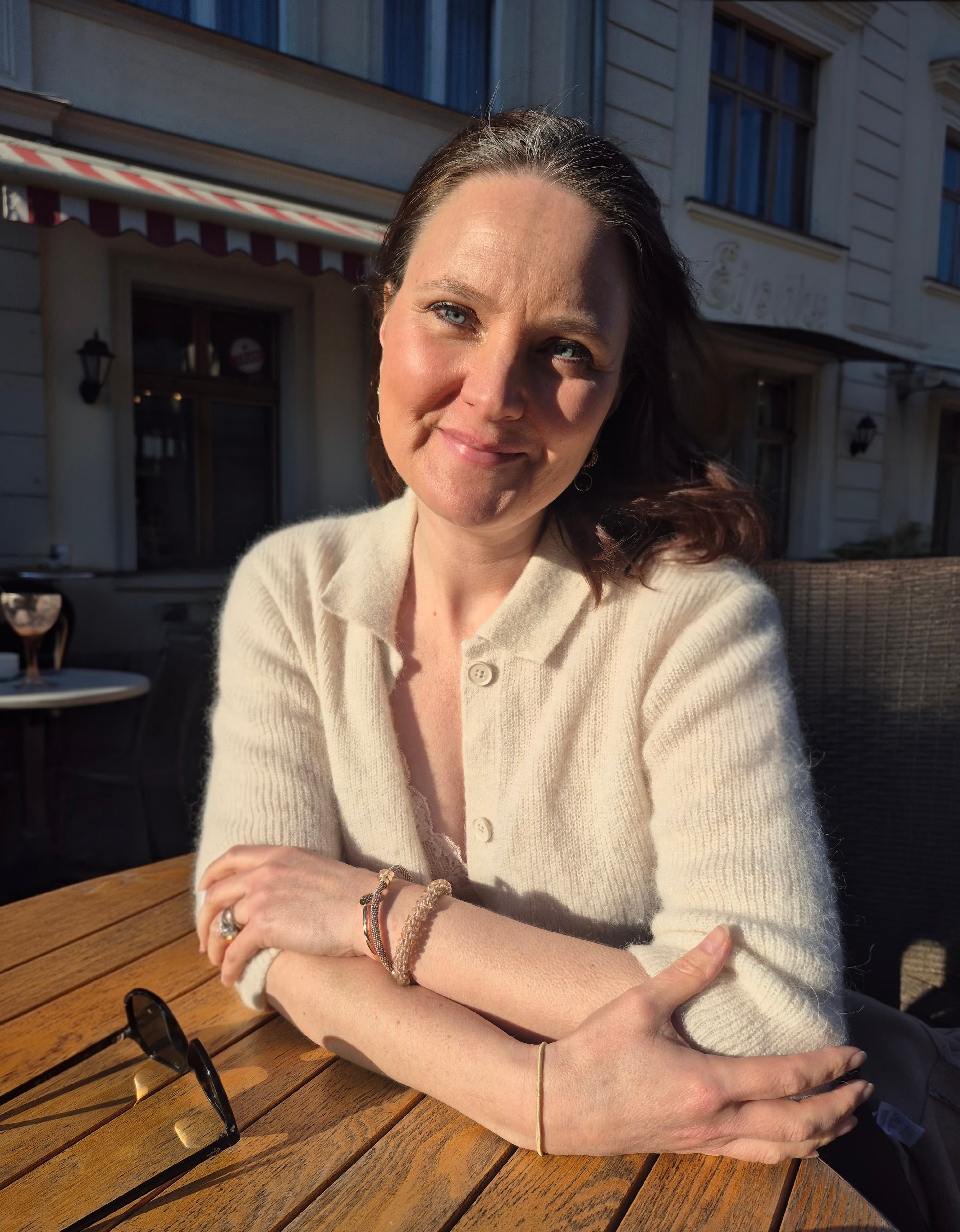
What I would hold in mind
From my own doula practice, the families who feel steadiest later are almost always the ones who started the midwife search early and let everything else wait. So if you do one thing this fortnight, make it that. Beyond it, these are quiet weeks: not much is asked of you until the first scan, and the flood of new German words can wait. I say this not as medical advice but as what I have seen, again and again, sitting alongside international families through these first weeks: you do not have to feel ready, or even happy, to be doing this well.
Read more
- Your Hebamme: who she is, how to find one
- What is the Mutterpass
- Essay: What your Hebamme does
- Printable: Your Hebamme
Signposting
Trusted help across Germany, beyond Birth & Mother:
- Ammely · no-cost midwife search, run by the German Midwives' Association
- Hebammenverband · the German Midwives' Association, with its own midwife search
If you would like to make sense of where you are and what is in front of you, an Orientation Consultation is one unhurried hour by video, for English-speaking families anywhere in Germany.
Second Trimester · Weeks 14 to 27The secondtrimester
You begin to settle in. Decisions start to ask for your attention.
What is happening
For many this is the kindest stretch. Energy returns, nausea often eases, and the early fear softens into something steadier, though if it does not, that is normal too. You begin to show. Somewhere in here you feel the first movements, fluttery and unfamiliar, then unmistakable.
You tell people, and the pregnancy stops being a secret you carry alone. There can be a quiet grief folded inside the joy: for the life that is changing, for family who are far away and cannot put a hand on your bump. Let both sit together. They often do.
Your care, as it unfolds
Care settles into a rhythm. Routine check-ups (Vorsorge) come roughly every four weeks, shared between your gynaecologist and your midwife however you have arranged it: blood pressure, urine, your baby's heartbeat, and the measure of your growing bump, all recorded in your Mutterpass.
The second ultrasound, the detailed anatomy scan, falls between weeks 19 and 22. Around weeks 24 to 28 you are offered the gestational diabetes screening (oGTT). This is also the season for birth preparation: antenatal classes fill up early, so the one you want is worth securing now.
Decisions and admin
Decisions to make
Admin & paperwork
What I would hold in mind
This is the phase that asks you to choose, and the pressure to choose “right” can be heavy. In my doula work the thing I find myself saying most often is that none of it is forever. Your birth setting can change. Your plan can change. What matters is not committing to the first option you read about, but understanding what is actually on offer where you live, and which of it sits well with you. When you tour a hospital or birth house, ask directly whether English-speaking midwives are on the team, and listen to how they answer.
Read more
- Where to give birth: hospital, Geburtshaus, home
- Mutterschutz: your maternity protections
- Essay: Choosing where to give birth
- Booklet: Before the Birth (antenatal)
Signposting
Trusted help across Germany, beyond Birth & Mother:
- Keleya · a week-by-week pregnancy app, in English and German
- familienportal.de · the official guide to Elterngeld, Kindergeld, and Mutterschutz
- Netzwerk der Geburtshäuser · the national network of German birth houses (Geburtshäuser), with a directory to find one
- Doula-Verbund Deutschland · a German doula association, with a directory to find a doula near you
If you would like to prepare properly, Gentle Preparation walks you through your options before labour, as live online sessions for families anywhere in Germany, or in person if you are around Potsdam and the Berlin and Brandenburg region. The Beautiful Birth Workshop is a smaller, women-only space focused on rights, fear, and how the room really works.
Third Trimester · Weeks 28 to 40+The thirdtrimester
The body is loud now. The paperwork asks you to confirm your plans.
What is happening
The body is unmistakable now, and loud. Sleep grows lighter, the baby is busy at all hours, and heartburn, aches, and a kind of nesting urgency arrive. Time starts to bend itself around the due date.
You will field well-meaning comments from strangers and questions about whether you are “ready.” Underneath the logistics there is often a tender mix of impatience, nerves, and awe. All of it is the right amount of feeling for what is coming.
Your care, as it unfolds
Check-ups quicken. The third ultrasound falls between weeks 29 and 32, and from week 32 your appointments move to every two weeks. Heart-rate monitoring (CTG) may begin. Around weeks 30 to 34 comes the registration appointment (Anmeldegespräch) at your chosen hospital, where your details and preferences go on file.
If your pregnancy passes the due date, your care team will offer extra monitoring rather than rush you. Threaded through all of this is the quieter work of getting ready: finishing your classes, writing your preferences down, and confirming who will care for you afterwards.
Decisions and admin
Decisions to make
Admin & paperwork
Deciding about Elternzeit and Elterngeld
The two parental leave decisions get confused often, so worth separating clearly. Elternzeit is unpaid, job-protected leave (up to three years per child, distributed flexibly between birth and the child's 8th birthday). Elterngeldis the financial support during leave (paid for up to 14 months per family, replacing 65 to 67 percent of net income, capped at €1,800 per month).
The Elternzeit request goes to your employer in writing at least seven weeks before it begins, and is binding for the first two years. The Elterngeld application goes to the parental allowance office (Elterngeldstelle) after birth, ideally within three months. For the full structure of how both work, see Elternzeit and Elterngeld.
What I would hold in mind
This is where families most often feel the squeeze: forms, opinions, and the sense that there is a “ready” you are supposed to reach. In years of sitting with families through these last weeks, I have never seen anyone arrive fully ready, and it has never mattered. What helps is knowing your rights, knowing who is on your team, and knowing where to go when labour starts. The rest you improvise, and you are allowed to.
Read more
- Booklet: Before the Birth (antenatal)
- Booklet: The Birth
- Elternzeit and Elterngeld: how it works
- Essay: Birth without your village
Signposting
Trusted help across Germany, beyond Birth & Mother:
- familienportal.de · the official guide to Elterngeld, Kindergeld, and Mutterschutz
- Elterngeld-Digital · the official online application for parental allowance (Elterngeld)
- La Leche Liga · non-commercial breastfeeding support, with local and online groups
- Schatten und Licht · support through peripartum depression in Germany, with English information
If you would like one steady presence with you through the birth, Continuity in Birth keeps the same familiar person beside you from late pregnancy through labour and the early hours after, in person around Potsdam and the Berlin and Brandenburg region. Further afield? The Beautiful Birth Workshop and live online preparation give you much of the same grounding, wherever you are in Germany.
Birth · The week around your baby's arrivalBirth and thefirst days
The door between two phases. Whatever happens, you will be on the other side of it.
What is happening
Labour, birth, and the first astonishing hours. It may begin as a slow build or arrive all at once; it may follow your plan or ask you to let the plan go. In Germany a healthy parent and baby usually stay in hospital one to three days; after a birth house or home birth you are often home within hours. Whatever the route, your midwife's postpartum visits begin almost straight away.
The feelings here are rarely tidy: elation and shock, tenderness and exhaustion, sometimes grief or disappointment threaded right through the love. Every version of this is allowed, and none of it is a verdict on how you did.

Your care, as it unfolds
At your chosen setting, the midwife leads the birth and doctors step in only if something needs them. You have the right to a companion, your partner, a doula, or both, and the right to understand and consent to (or decline) every intervention.
Your baby's first check (U1) happens immediately after birth, and the second (U2) between days 3 and 10, usually before you leave hospital or at your first home visit. Then your midwife begins daily home visits through the first ten days: checking your recovery and the baby's, supporting feeding, weighing, and answering the questions that always seem to come at 3am.
Admin & paperwork
Admin & paperwork
What I would hold in mind
Birth rarely looks like the plan, and from everything I have witnessed in this work, that is not a failure of preparation. Preparation is simply what gives you something to return to when the day turns. The first 48 hours are loud and disorienting even at their best, so do not expect yourself to remember everything. You will tell the story of this birth many times in the years ahead, and the version that matters is the one that is true for you.
Read more
- Booklet: The Weeks After (Wochenbett)
- Booklet: The Birth
- Essay: Baby paperwork in Germany
- The paperwork checklist at a glance
Signposting
Trusted help across Germany, beyond Birth & Mother:
- Familienkasse · where you apply for child benefit (Kindergeld)
If your birth was not the one you hoped for, or you simply want to put words to what happened, Your Birth Story is a gentle, evidence-based place to be heard and to find the right support, for families anywhere in Germany.
Fourth Trimester · PostpartumThe fourthtrimester
A real phase, not a pause.
What is happening
The Wochenbettis Germany's name for the first weeks after birth, held as a protected, slow, mostly indoor time. Healing, feeding around the clock, broken sleep, the strangeness of a body that is suddenly yours again and not quite the same, and a baby who knows nothing yet of day or night.
There is love that floors you and, often, a low tide of tears, loneliness, or anxiety, especially without grandparents down the road or a familiar food on the stove. None of that means you are doing it wrong. It means you are in it, and this is precisely the stretch the German system expects you to be cared for, not just the baby.
Your care, as it unfolds
Your midwife is the centre of this phase: daily visits for the first ten days, then less often through the first eight weeks, with breastfeeding support (Stillberatung) available for months after. Your baby's check-ups continue, with U3 around weeks 4 to 5, and at about six weeks a postnatal check (Nachuntersuchung) with your gynaecologist closes the formal medical postpartum.
From around week six a postpartum recovery course (Rückbildungskurs) begins, covered by your insurer. Beneath the appointments, the real work is rest, food, and being looked after, which Germany genuinely expects you to take seriously.
Decisions and admin
Decisions to make
Admin & paperwork
What I would hold in mind
In my postpartum work the single biggest difference between a gentle Wochenbett and a brutal one is not the birth, it is whether the parents have help and rest in the weeks after. If your family is far away, build a substitute on purpose: a friend on a meal rota, a neighbour for the shopping, a paid pair of hands for the laundry, a doula for the steadier presence. And ask before you are desperate, not after. That, more than anything I have learned alongside the families I work with, is what I wish everyone knew going in.
Read more
- The Wochenbett: a complete guide
- Printable: The Wochenbett
- Essay: The fourth trimester in Germany
- The full U-Untersuchungen schedule
Signposting
Trusted help across Germany, beyond Birth & Mother:
- Postpartum Support International · postpartum mental-health support, in English
- Schatten und Licht · support through peripartum depression in Germany, with English information
If you would like care that takes the Wochenbett seriously, Daily Healing is shaped around these first six weeks, available by video for families anywhere in Germany, and as in-home care if you are around Potsdam. And for company in person before birth, the Birth & Mother Club gathers mothers in Potsdam.
At a glance
The paperwork checklist
The single most useful thing an international family can have is a clean list of the practical, paperwork-shaped tasks across pregnancy and the early weeks. Here is the whole timeline in one place, in order. Tick each one off as you go.
Across the months
Insurance, phase by phase
Most of what your maternity care costs is paid by your health insurance (Krankenkasse) directly, so you rarely see a bill. The moments when it is worth picking up the phone to them:
- 01
First trimester
As soon as you know you are pregnant, it is worth getting a few things in place with your insurer:
- Check your bonus programme (Bonusprogramm). Many insurers reward pregnancy check-ups and courses with points or money back toward extras.
- Download your insurer's pregnancy app and any documents or welcome pack. Most offer one, often with reminders and English-language material.
- Ask which individual health services (IGeL) they offer or contribute to. These sit outside the standard covered care and are otherwise paid privately. Common ones in pregnancy include extra ultrasounds, toxoplasmosis and CMV screening, group B streptococcus (GBS) testing, and Doppler scans.
If you are on private insurance (PKV), also ask specifically about midwife care, birth setting, and any on-call fees (Rufbereitschaftspauschale). On statutory cover (GKV), the routine care is covered without a call.
- 02
Mid pregnancy
Check what extra support your insurer offers. Some run midwife matching (Hebammenvermittlung) and some reimburse non-routine ultrasounds or tests. Many also have a helpline or counselling for a difficult or high-risk pregnancy: worth noting the number before you might need it.
- 03
Late pregnancy
At the hospital registration appointment (Anmeldegespräch), your insurance details go on file at the birth setting, so bring your insurance card. This is also the moment to ask what options exist for reimbursing a family room (Familienzimmer), so a partner can stay overnight; cover varies by insurer and some will contribute toward the cost.
- 04
First week after birth
Register the baby with your health insurance; it can take a few weeks to issue their card.
- 05
First weeks postpartum
Confirm that the postpartum recovery course (Rückbildungskurs) and any breastfeeding consultations are paid through your insurer. Ask too about osteopathy: many insurers reimburse part of a set number of osteopath sessions, which some parents use for themselves or the baby in the weeks after birth.
For the full picture of what statutory and private insurance cover and how each works structurally, see Krankenkasse coverage.
For families across Germany
Trusted resources
Rules and figures change, and your own city will have its own offices and groups. For the current, official word, and for finding the people who can help near you, these are the places worth bookmarking, wherever in Germany you are.
- Ammely · no-cost midwife search, run by the German Midwives' Association
- Hebammenverband · the German Midwives' Association, with its own midwife search
- familienportal.de · the official guide to Elterngeld, Kindergeld, and Mutterschutz
- Familienkasse · where you apply for child benefit (Kindergeld)
- Keleya · a week-by-week pregnancy app, in English and German
- Doula-Verbund Deutschland · a German doula association, with a directory to find a doula near you
- Postpartum Support International · postpartum mental-health support, in English
- Schatten und Licht · support through peripartum depression in Germany, with English information
- Netzwerk der Geburtshäuser · the national network of German birth houses (Geburtshäuser), with a directory to find one
- Elterngeld-Digital · the official online application for parental allowance (Elterngeld)
- La Leche Liga · non-commercial breastfeeding support, with local and online groups
More from Birth & Mother
Continue exploring
This checklist is a starting point. There is more to read, more to print, and a person on the other end of all of it.
The companion read
The Whole Journey
The same path in warm, comprehensive prose, from your positive test to the weeks after.
Essays
The Birth & Mother Journal
Personal writing on birth, motherhood, and finding your feet in Germany.
About
Meet Emma
Welsh-born, Potsdam-based, English and German speaking doula who has lived this journey.
Offerings
All packages and offerings
Birth preparation, presence in birth, Wochenbett care, debrief, workshops, community.
When to call for help
If something feels urgent
Worth saving these numbers in your phone before they are needed. In Germany, the answer is rarely “go to the hospital and wait.” It is usually “call this number first.”
112 · Notruf
Life-threatening emergencies: heavy bleeding, sudden severe pain, loss of consciousness, no baby movement for an extended time, a fall, anything that genuinely frightens you.
116 117 · Ärztlicher Bereitschaftsdienst
Out-of-hours medical advice when your gynaecologist's practice is closed and the concern is not a 112-level emergency. At no charge across Germany.
Your midwife
For questions about pregnancy symptoms, postpartum recovery, feeding, and the baby. Agree at your first contact how they prefer to be reached.
Your gynaecologist
For pregnancy-related medical concerns during practice hours, and anything flagged in your routine check-ups.
In labour: call the labour ward (Kreißsaal) of your registered hospital directly. The number is in your Mutterpass after your registration appointment. For a birth house or planned home birth, call your midwife.
A note on what is and is not in this guide
This is informational, not medical advice. Your midwife (Hebamme) and gynaecologist are your primary care; everything on this page is the orientation that comes before, between, and after their appointments, drawn from my doula practice and my own experience of this system as an international mum. If you would like a calm, English and German speaking presence as you move through any of these phases, get in touch.
Your journey through the guides
- The System
- Your Hebamme
- Where to Birth
- Birth Changes Course
- Step by Stepyou are here
- The Wochenbett
- The First Year