Finding Your WayGiving birth in Germany:what I did not know
From your Mutterpass to finding a midwife, booking a hospital, and what your insurance covers.

Written by Emma, Birth & Mother
September 11, 2026 · 9 min read
My first baby was born in the UK, before we came to Germany. It was a hard birth and a harder few weeks after it, and I did not understand much of what was happening at the time. I asked for things I did not get. I have thought about it a great deal since.
Nine months after she was born we moved to Germany. I became pregnant with my second daughter two years later. I did not speak German and I did not know how any of it worked here. What I did know was that I wanted something different from the first time, and that I would have to ask for it in a language I was still learning.
This is what I met, in the order I met it. The practical version, without my story in it, is in my guide to the German maternity system.
The Mutterpass: The Booklet I Was Handed
At my first appointment with a gynaecologist here I nodded along to words I did not understand. Someone handed me a small blue booklet as though I would know what it was, and I didn't.
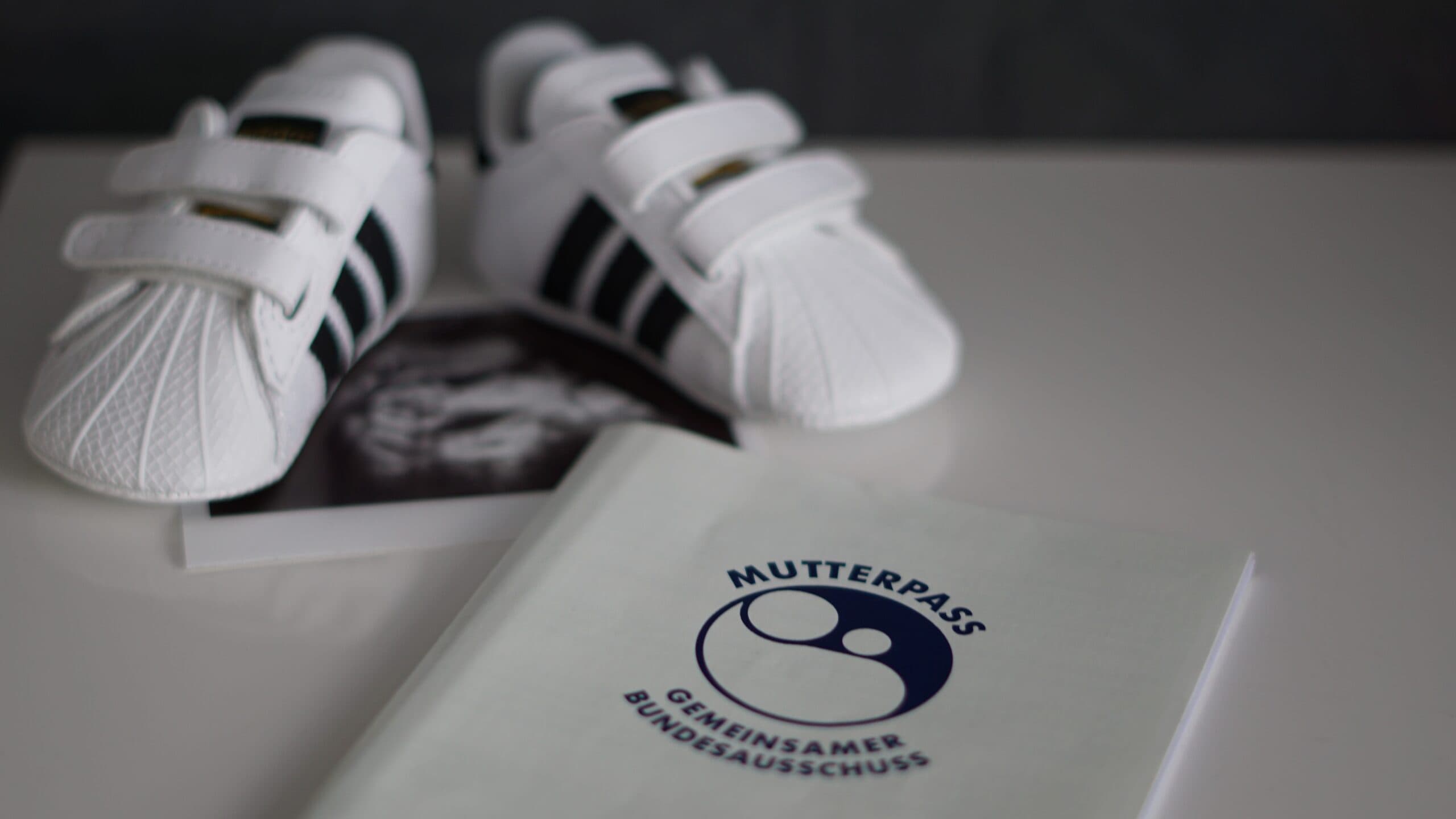
It is the Mutterpass, and it is the record of the whole pregnancy: your blood type, your blood pressure and weight at each visit, the ultrasound findings, the position of your baby. Keep it in your bag. Any doctor you see while you are pregnant, including one who has never met you, can read your history out of it in a minute.
It is all in German, and the abbreviations are dense. Nobody went through it with me, so for the first months I carried it about without knowing what was written in it. I go through it page by page with the families I work with now, early on, because being able to read your own record is what makes it possible to ask about it.
Finding a Hebamme: Start Early
My second pregnancy was the first time I had a midwife of my own. She spoke English, and after the birth she came to the house every day for twelve days. I did not know, in my first pregnancy, that this was something you could have at all.
Start looking as soon as you know you are pregnant. There is a shortage of midwives in Germany, and in cities like Potsdam and Berlin many are fully booked months ahead. The families I work with who feel steadiest later are almost always the ones who started writing to midwives in the first weeks.
A midwife here is not only for the birth. They can see you at home during the pregnancy for check-ups, and they come to you afterwards, through the Wochenbett. Both are covered by your insurance.
Who is with you during labour depends on where you give birth. In a hospital it is usually the midwife on shift (Klinikhebamme), whom you meet on the day. A midwife who comes in with you instead is a Beleghebamme, and the word to look for is Beleg: it means she has a contract (Belegvertrag) with that particular hospital, and without one she cannot attend your birth there at all. So ask her early which hospitals she holds a Belegvertrag with. Some hospitals have a team of Dienst-Beleghebammen covering the ward in shifts, which means you get whoever is on. A home-birth midwife (Hausgeburtshebamme) attends births at home, and birth houses (Geburtshäuser) have their own midwives. Which of those is right is whichever fits you, your family, and your wishes for this birth. None of this was explained to me. I worked it out afterwards, which is the wrong order, and I can share my experiences with you now.
Where to look:
- Search by your due date and where you live: ammely.de is the nationwide midwife-matching platform of the Deutscher Hebammenverband, the largest professional association of midwives in Germany. It is free, and unlike a plain directory it matches on a midwife's free capacity as well as her area
- Ask your gynaecologist's practice: they often keep a list of the midwives working nearby
- Ask in local groups for international parents: the groups in your own city will have names, and will tell you who answered
- Write to several at once: waiting to hear back from one before writing to the next costs weeks you may not have
One cost to ask about early: a Beleghebamme or a home-birth midwife usually charges a fee for being on call for your birth (Rufbereitschaftspauschale). It is not part of the standard insurance catalogue, and how much of it your Krankenkasse gives back differs from one Kasse to the next, so ask yours what it pays before you agree anything.
Many midwives here speak some English. If German is not your language, say so in the first email and ask directly whether they can work with you in English.
The Appointments: What Happens at Them
Prenatal care here can be led by your gynaecologist or by a midwife, and it is your choice which. A midwife can carry out the same check-ups, apart from the ultrasounds and the finer diagnostics, which a gynaecologist does. Appointments are every four weeks to begin with, every two weeks after week 32, and weekly near the end.
Some of it comes round at every visit: your weight and blood pressure into the Mutterpass, a urine sample, a measurement of the growth of your uterus, and your baby's heartbeat, with a doppler early on. The rest is spread across the pregnancy rather than repeated. Three ultrasounds are covered as standard, at roughly weeks 9 to 12, 19 to 22 and 29 to 32, with more if there is a clinical reason for them. Blood tests come at set points, for your blood type, antibodies, infections and gestational diabetes. A CTG, which records your baby's heartbeat over a stretch of time rather than listening to it for a moment, belongs to the later weeks, or earlier if there is a reason for it.
Nobody talked me through any of that in advance, so for the first few I braced myself for something and then walked out four minutes later, none the wiser about what had just been written down.
The appointments themselves are short. The findings go in your Mutterpass, and questions get answered if you ask them. I did not ask many, the first time round, because I did not know what there was to ask.
Registering at the Hospital: The Kreißsaalanmeldung
Between about week 32 and week 36 you register at the hospital where you plan to give birth. This is the Kreißsaalanmeldung: paperwork, a run through your medical history, and often a look at the delivery rooms.
I chose a hospital that would let me birth with as few interventions as possible, and I said so when I registered. I had been through an induction the first time, and an epidural whose after-effects were still with me years later. I did not want either again. So I went back to hypnobirthing, properly this time, which for me meant practising it daily rather than reading about it: the breathing, and learning to stay with the sensations instead of bracing against them. What I wanted from it was to be calm enough to stay at home for as long as I could, and to arrive already well into my labour. I will write about that next.
At the appointment a doctor or midwife goes through your Mutterpass and notes anything that matters medically. It is also when you can say what you would like for the birth. Writing it down in German as well as English means it can be read by whoever is on shift on the day, who may not be the person you registered with. Most hospitals also hold information evenings (Infoabende), where you can see the rooms and ask questions before you decide, and some run them in English.
My labour started at ten in the morning on my due date. I was at home for six hours, in the dark, quiet and on my own, and I was calm in a way I had not been the first time. I have wondered since how close I came to having her at home.
What Your Insurance Covers: <em>Krankenkasse</em>
Whether you are publicly insured (gesetzlich versichert) or privately insured (privat versichert), your pregnancy care, the birth and your postnatal midwife visits are covered. The differences are in the detail, and the detail is easier to read now than in the week you need it.
With public insurance the standard appointments are covered, including those three ultrasounds and the blood work, and so is your midwife, both the check-ups during the pregnancy and the home visits afterwards. The birth in hospital is covered as part of the standard hospital services (allgemeine Krankenhausleistungen), and unlike other hospital stays a birth carries no daily co-payment. A birth preparation course (Geburtsvorbereitungskurs) is covered for you, though your partner's place is sometimes charged separately.
Two things in there are worth reading twice, because I did not understand either of them until later. A shared room is what is covered: a two-bed room, a single room or a family room is a Wahlleistung, which you pay for yourself or through a hospital top-up insurance, and what is on offer differs from one hospital to the next, so ask the one you are registering at. And the postnatal recovery course, up to ten hours in a group with a midwife who bills your Krankenkasse directly, has to be finished by the end of the ninth month after the birth. Nine months to finish, not nine months to start, which is an easy thing to read the other way round. There is no rule about the earliest start; that is between you and your midwife.
Private policies often include more: extra ultrasounds, or a single room. What yours covers is in your own contract, so that is the thing to read. Anything it does not say plainly is worth putting to your insurer in writing. A Beleghebamme or a birth at a birth house can need approval first, so ask about those early.
The Weeks After: What I Planned for the Second Time
After my first baby I was on a six-bed ward for five nights while an infection cleared. My husband had two weeks' leave and spent the first night of it upright in a hospital chair. When we got home there was no meal train and nobody popping in with a cup of tea. I ordered my meals on Uber Eats. I cried most nights of what I had expected to be a blissful postpartum.
The second time I planned it. I asked my mother to come for two weeks after my second daughter was born, and the difference was remarkable. She kept the house, my husband and my eldest, and I kept the baby. She made soups and warm drinks, and fed me without my having to ask. I wanted forty days of that, and between my mother, my husband, my in-laws and our neighbours we made it work.
My midwife came every day for twelve days. Those visits are the part of the system here I would tell any new mother to use in full: she weighed the baby, looked at how feeding was going, checked how I was healing, and asked how I was, every day, for nearly two weeks. Nobody had asked me that, daily, the first time.
What a Doula Can Help You With: and What She Cannot
A doula is not a medical professional. She does not examine you, she does not give medical advice, and she does not make decisions for you. That is worth saying plainly, because it is the part people are least clear about.
Almost everything I do now is something I wish someone had done for me. A doula comes to appointments with you and tells you afterwards, in your own language, what was said. She helps you write your preferences down in German so that they can be read on the day. When a letter comes from your Krankenkasse, she tells you what it is asking for, or who can answer it properly. She is at the birth having already met you, so that someone in the room knows what you wanted before the contractions started. And she comes back afterwards, in the weeks when the visitors have stopped and the house goes quiet.
Doula care is not covered by German health insurance. Doulas are not part of the regulated medical system here, so it is paid for privately.
What I know now, and did not know then, is how much of this you are allowed to ask for. The midwife at home. The hospital that suits you. The forty days. None of it was hidden from me. I just did not know it was there.

Emma
Certified Birth Doula & Founder of Birth & Mother
Join the conversation
Share This Article
Before you go
I'd love to hear from you
Community
Women in Potsdam, going through it alongside you
Local announcements and a circle of English-speaking mothers in Potsdam and Berlin-Brandenburg.
Join us on Telegram →Guide Me
Not sure what you need next?
Answer a few questions and I'll map the care that fits where you are, from pregnancy through the Wochenbett.
Find the care that fits you →Want someone to walk this road with you?
Doula care is steady, personal support through pregnancy, birth, and the early weeks with your baby. If you'd like someone in your corner, here is how we can work together.
Explore doula care →Stay Connected
Get new posts delivered to your inbox.
By subscribing you agree to receive Journal updates by email. You can unsubscribe at any time. We use a double opt-in: you'll receive a confirmation email before being added. See our Datenschutzerklärung.